
The Public Square · Interview
Editor’s Note: This interview was conducted by Emma Bice, a Master of Public Policy candidate at Southern Methodist University.
Professor Phil Ritter brings decades of experience in transportation policy and public affairs to his role at Southern Methodist University’s Master of Public Policy program. Having worked in executive management at Dallas–Fort Worth International Airport (DFW), he developed expertise in aviation governance, regional planning, and public finance, Ritter offers a grounded perspective on the forces shaping commercial aviation in North Texas and beyond.
In this interview, conducted as part of an academic research project on transportation policy, Ritter reflects on the historical, legal, and technological dimensions of aviation policy, from the origins of the Wright Amendment to the promise and challenge of artificial intelligence in airspace management. The interview has been edited for length and clarity.

About your background in transportation policy, what drew you to this field?
When I was in school, transportation policy was something that really interested me.
I wrote a letter to a professor at the LBJ School of Public Affairs at UT-Austin. I had already gone to law school, and he wrote back a two-page, single-spaced letter on transportation policy: why I should go to UT, airports, roads, all of it. I have loved the field ever since. It is a fascinating industry, and the people in it are tremendous.
Dallas–Fort Worth has a unique aviation history, especially with policies like the Wright Amendment shaping competition between airports. From your perspective, how have past policies influenced the competitive landscape between airports such as DFW and Dallas Love Field?
Whatever the policy history has been, it sure worked out well. We have two of the best airports in the country. A big part of that success has nothing to do with policy, but rather geography: being right in the center of the country, with Mexico to the south, Canada to the north, and the Caribbean accessible as well. For readers who want the full history, I recommend Prairies to Plains by SMU Professor Darwin Payne. It covers the entire development of DFW Airport and is essential reading for anyone serious about this region’s aviation history.
To summarize the key policy arc: Back in the 1960s, Dallas and Fort Worth were separate, fast-growing cities with quite a rivalry. I sometimes refer to it as a bipolar disorder. Both were independently pursuing hub airports. The FAA stepped in and essentially said it would not fund two major hub airports that close together. The agency cited both safety concerns around airspace management and the problem of duplicative, costly infrastructure. The federal government told the two cities to come up with a regional plan, and they did. It was, as some like to say, a shotgun marriage, with the federal government holding the shotgun.
Financing the new airport proved complicated. Regional elections were held in both cities to authorize a sales tax that would serve as a revenue stream for the bonds needed to build the airport. The measure passed in Fort Worth but failed in Dallas, creating an impasse.
The solution, brokered between the respective mayors, was a contractual governance agreement. Each city would use its own bonding capacity rather than creating a single airport authority. That structure still governs DFW.
The deal also required both cities to shut down their municipally owned airports for commercial aviation purposes. When DFW opened, however, Southwest Airlines had just begun operations and was flying exclusively intrastate routes within Texas. Southwest argued that the airport closure agreement applied only to interstate commercial aviation, not intrastate flights, and that argument triggered years of litigation.
Fort Worth’s congressional representative, Jim Wright, who later served as speaker of the U.S House, ultimately shepherded through the legislation that bore his name: the Wright Amendment. In its original form, the Wright Amendment permitted Southwest to operate out of Love Field but restricted its routes to Texas and immediately adjoining states — Louisiana, Arkansas, Oklahoma, and New Mexico. Southwest accepted those terms and continued to grow, as did DFW and American Airlines.
For roughly two decades, both sides abided by the arrangement. Then Southwest began aggressively lobbying for changes, and the battles of the 1990s and early 2000s were significant. They were fought in Congress, with Dallas, Fort Worth, American, and Southwest all competing for votes. Interestingly, much of the congressional support for expanding the Wright Amendment came from states outside Texas. Communities across the country wanted Southwest service, believing it drives down ticket prices through competition.
The issue came to a head in the early 2000s. The resulting compromise repealed the geographic flight restrictions at Love Field but capped the airport at 20 gates and prohibited international service. The gate cap was driven largely by surrounding neighborhoods that did not want around-the-clock operations, or the noise associated with an international hub. Fort Worth accepted the lifting of geographic restrictions; Dallas accepted the cap. That resolution has held, and both airports have flourished as a result.
Competition has been good for prices, and our region is fortunate the issue is resolved.
Major airports like DFW, Love Field, and Houston’s George Bush Intercontinental Airport are significant economic engines for their regions. How do transportation policymakers balance the economic benefits of expanding air travel with infrastructure costs and environmental concerns?
On infrastructure costs, airports have remarkably diverse revenue streams: landing fees from commercial, cargo, and general aviation; parking, which is substantial; terminal concessions, which operate essentially as shopping malls; commercial real estate development on airport-owned land; and tolls, of which the airport receives a portion.
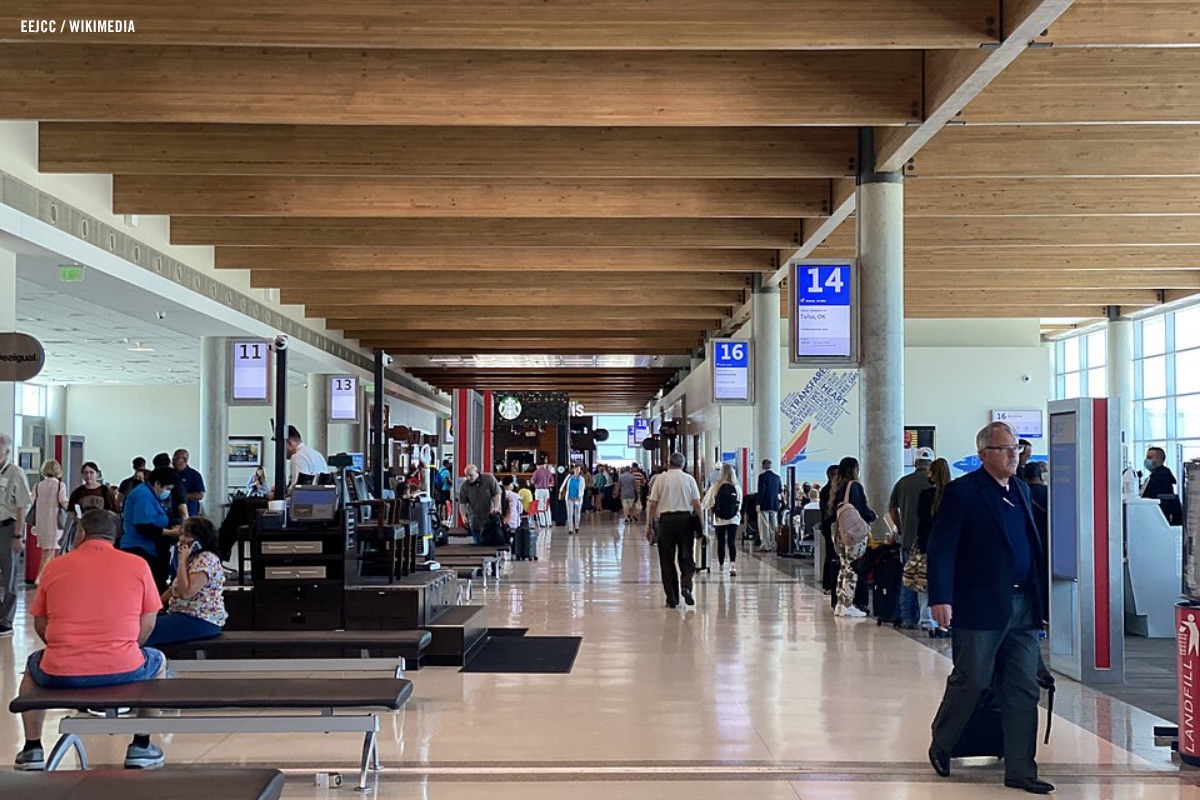
DFW, for instance, has approximately 18,000 acres, roughly the size of the island of Manhattan. Only about a third of that land is needed for airfield operations. The remainder has developed into warehouses, commercial facilities, and other revenue-generating uses.
If you have a large, long-term revenue stream, you can issue bonds at favorable rates and finance infrastructure over 30 years, much like a home mortgage. DFW likely carries several billion dollars in debt, serviced over decades through those revenue streams.
For anyone interested in this industry from a policy perspective, I cannot overstate the importance of understanding public finance and how airport bonding works. Airlines themselves pay very close attention to it, because they ultimately guarantee the bonds that cities issue.
On environmental sustainability, I think about three distinct vectors. The first concerns aircraft themselves. This is primarily a challenge for airlines and aircraft manufacturers — Boeing and Airbus above all — rather than for airports, which are essentially landing infrastructure. That said, the progress has been remarkable. Modern commercial aircraft are dramatically more fuel-efficient than earlier generations. This matters for environmental reasons and for airline economics, since fuel is the largest variable cost in airline operations.
The second vector is airport operations. When aircraft emissions are excluded from the calculation, DFW is actually a net carbon-zero facility. The airport invites providers to compete for its electricity contracts while requiring that a defined percentage come from renewable sources. New terminal construction is universally LEED-certified. Operational efficiencies, window treatments to reduce heat gain, and optimized HVAC systems are standard practice. These are not unique to airports, but aviation has been particularly committed to them.
The third vector is intermodal connectivity. Airports are not just aviation hubs; they are nodes in a broader transportation network. Reducing the energy cost of getting passengers to the airport, particularly through mass transit, is a significant sustainability lever. Virtually every major airport in the world now has a rail or mass transit connection. DFW has rail lines running from both Dallas and Fort Worth, as well as bus service.
The challenge in Texas, and in many Sun Belt cities, is that the culture and infrastructure are organized around the automobile. Shifting that requires long-term regional planning, which is something metropolitan planning organizations are intensely focused on.
Airport and transportation policy involve many levels of government — federal aviation regulation, local airport governance, environmental review, and more. Where do you see the greatest policy tensions between federal priorities and regional or local transportation goals?
I would not characterize the relationship as one of constant conflict. There is actually substantial alignment. In many respects, aviation is a policy area that functions relatively well across jurisdictional levels. That is somewhat unusual.
The framework begins at the international level. The International Civil Aviation Organization (ICAO), established after World War II, sets global standards for airspace, runway specifications, lighting, radio frequencies, and a range of engineering and aviation operational requirements. The Federal Aviation Administration (FAA) aligns with those standards. Given the volume of U.S. air traffic and the depth of American aviation expertise, the FAA is arguably the most influential national body in shaping international standards. Domestically, city-owned airports operate within a well-understood regulatory framework. On the operational side, the system works well — it is, in many respects, a model of intergovernmental coordination.
The 1978 Airline Deregulation Act, signed by President Carter, established the current economic framework. By and large, the federal government takes a hands-off approach to airline economics. The Department of Justice and FTC are active on antitrust and market concentration issues. Individual air routes can function as distinct markets, and predatory pricing behavior — where one carrier tries to drive another out of a specific corridor or market — does attract federal scrutiny.
One area of genuine and persistent federal-local tension is what is known as revenue diversion. In the 1970s and 1980s, several cities, Chicago being the most egregious example, were systematically diverting airport revenue to fund general municipal services: police, fire, streets, etc. The airports deteriorated as a result.
The federal response was a series of FAA regulations prohibiting airports from diverting most types of airport-generated revenue for non-aviation purposes. In practice, this creates real friction. During my time at DFW, both Dallas and Fort Worth regularly pressed the airport for ways to extract greater economic value for the owner cities. When cities run into the limits imposed by federal revenue diversion rules, the frustration is palpable.
There are, however, compliant ways to generate regional economic value from an airport. Traveling to potential markets to recruit airlines for new international routes is one example. During my time at DFW, those international outreach efforts resulted in new nonstop service to Australia and to Dubai, which generates significant regional economic activity. The federal regulations permit that kind of investment; they simply prohibit transferring airport revenues directly to fund non-aviation municipal services.
The U.S. Department of Transportation has an important role in allocating international air routes to carriers. There is regular federal-local tension around international air service allocation. Bilateral aviation treaties between the United States and foreign countries establish limits on the number of flights permitted between the two countries.
When new routes become viable — say, a nonstop to Shanghai that is now feasible because airlines have acquired aircraft with sufficient range — cities compete at the federal level for authorization to serve that route. DFW has, at various times, competed against Chicago and other major hubs for international route approvals. That is a quiet, but real dimension of aviation policy where local economic interests play out through federal processes.
Since airline deregulation in 1978, competition and pricing in the airline industry have changed dramatically. What aspects of airline policy still require government oversight, and where should markets be allowed to operate freely?
On safety and airspace management, government oversight is non-negotiable. You cannot afford mistakes in those domains. I value the fact that federal regulators are looking over the industry’s shoulder. Airlines may always intend to do the right thing, but external oversight is essential — and the public expects it.
Where the federal government has genuinely fallen short is in its capacity to modernize. Air traffic control remains heavily reliant on radar-based systems that are, by any reasonable measure, outdated. The transition to next-generation technology — GPS-based navigation, data integration, and increasingly, artificial intelligence — has been slow, caught up in annual budget battles and the instability created by government shutdowns. Air traffic controllers work under extraordinary stress, managing high volumes of traffic with tools that have not kept pace with the complexity of the system they are managing. The mental health consequences for controllers are real and documented.
The federal government’s core responsibility in aviation is public safety. Meeting that responsibility requires sustained, reliable funding … and that has not always been forthcoming. Shutdowns that result in TSA officers missing paychecks, or that freeze hiring at major airports, are not just administrative inconveniences.
They represent a failure to honor the government’s fundamental obligations. The appropriate answer is not less government involvement but more disciplined, adequately funded government involvement, focused on its core mission.
Emerging technologies — autonomous aviation, advanced air mobility, electric aircraft — are generating significant attention. How do you see these developments affecting transportation policy for major airports?
Technology in this sector is, as in many others, running ahead of regulation. That gap will create both opportunities and challenges for policymakers.
On the artificial intelligence side, the opportunities for improving safety are profound and developing. The potential to augment or eventually transform air traffic management through AI is real, though realizing it will require both technological development and regulatory frameworks that are in their infancy. There is important work to be done at that intersection.
Airports are already deploying advanced technologies in less visible ways. Location data, purchasing history, and push-notification systems are being used inside terminals to optimize concession revenue — tracking passenger behavior and offering targeted incentives in real time. Airlines actively support these investments. Higher terminal revenue helps offset landing fees. These data-driven operational practices will only become more sophisticated.
On autonomous aviation and electric aircraft, I will be candid: the precise policy implications remain unclear, and I would be cautious about anyone who claims otherwise.
What I would recommend for researchers and students tracking this space is engagement with the two primary industry trade associations: the Airports Council International (ACI), which represents airports, and the Air Transport Association (ATA), which represents airlines. Both organizations maintain active technical and policy committees, and both are producing position papers for Congress and the FAA on exactly these questions. Their publications represent the most current thinking from practitioners on how emerging technologies should be regulated and integrated.
For students and emerging professionals interested in transportation or aviation policy, what skills and areas of knowledge do you consider most important for shaping the future of the industry?
The first is finance. I would put this above everything else. Understanding how airports are capitalized, how bonds are structured, and how revenue streams are pledged are very important. So is the ability to read and interpret financial statements. Policy professionals who understand the financial architecture of the industry are simply more effective. They understand why decisions get made, who has leverage, and where the real constraints lie. This is not optional knowledge for someone who wants to work in aviation policy at a serious level.
The second is marketing and communications. Airports and airlines are both commercial enterprises — one publicly owned, one private — and both are intensely focused on customer growth and satisfaction. Understanding how they market themselves, how they compete for passengers and routes, and how they manage their public relationships is genuinely useful knowledge, even for those whose primary orientation is policy rather than business.
The third is a broad understanding of the business itself, not just its policy dimensions. Early in my career, I was a lawyer at Texas Instruments who wanted to move into government relations. My supervisor, the general counsel, told me to go spend time in the business first — to understand how the company worked before trying to influence the policy environment. That was among the best professional advice I have received.
For someone with policy ambitions in aviation, a few years working in finance at an airline, or in operations or marketing at an airport, would be extraordinarily valuable preparation.
The industry is interdisciplinary by nature. The most effective people in it have broad exposure across functions. For those entering the job market now, I would encourage intentionality about the range of experiences you seek, not just the title or organization. When you are interviewing, signal that you want rotational exposure — finance, HR, operations, marketing — and look for employers who will provide it. A policy career built on that kind of operational foundation will be more durable and more impactful than one built purely on academic preparation, however strong.
Professor Phil Ritter teaches transportation and urban policy in the Master of Public Policy program at Southern Methodist University. He previously served in a leadership capacity at Dallas–Fort Worth International Airport.
Request information
To learn more about the Master of Healthcare Administration, Master of Public Administration and Master of Public Policy programs at SMU and download a brochure, please fill out the form. You can also talk one-on-one with an enrollment specialist directly by calling 469-871-6018.
