
The Public Square · Featured Policy Analysis
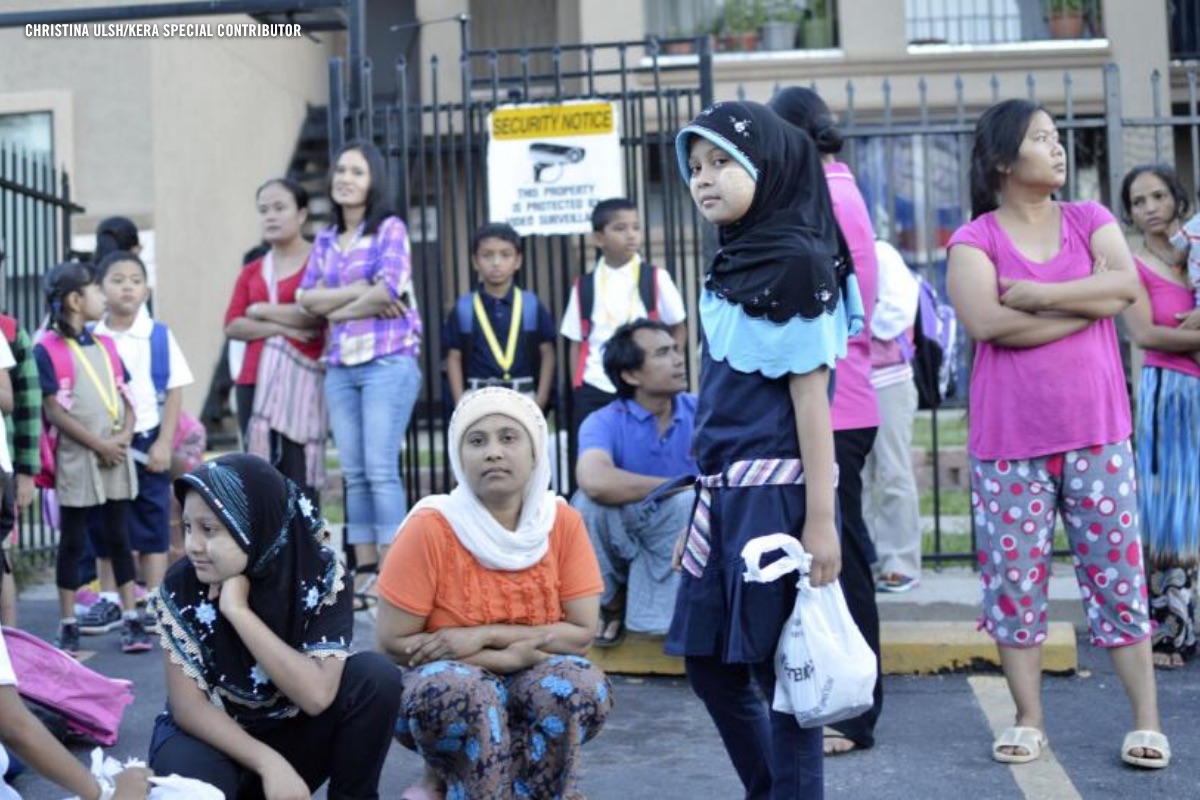
Texas leads the country in refugee resettlement, with over 40,000 refugee arrivals (opens in a new tab) in the last decade contributing to the state’s incredibly diverse population. Within this landscape we have Vickery Meadow — a neighborhood nestled in northeast Dallas, a mere 2.5 square miles, serving as the primary arrival gate for incoming families in the city.
Frequently termed the “Little UN,” the neighborhood density is an anomaly in car-centric North Texas. In contrast to the Hollywood-like mansions of Highland Park a few miles south, Vickery Meadow is primarily made up of multi-family apartment complexes. The neighborhood offers critical baseline infrastructure for new arrivals: walkable streets, access to transit lines, proximity to food banks, and resettlement agencies. Yet it also exposes a central tension in urban housing policy — what happens when the only housing available to newly arrived refugees is systematically distressed?
The economics of vulnerability
Under U.S. immigration law and guidelines set by the U.S. Citizenship and Immigration Services (USCIS) (opens in a new tab), refugees enter the United States with lawful status and work authorization. After one year of physical presence, they are required to apply for lawful permanent residency. Their arrival, though legal, is not without immediate barriers to economic self-sufficiency
Language gaps. Education and credential recognition gaps. Limited understanding of U.S. lifestyle systems. They all create hurdles for refugees and immigrants as they try to assimilate.
At the same time, refugees face subsequent difficulties finding stable income. Federal Reception and Placement (R&P) assistance (opens in a new tab) under the U.S. Refugee Admissions Program (opens in a new tab) exists to mitigate some of this financial stress. But R&P assistance only covers the initial 90-day arrival window.
Median market rents in the Dallas, Texas, area exceed $1,400. (opens in a new tab) While aging, but popular, Vickery Meadow apartment complexes offer rent prices that are almost impossible to find elsewhere in the area. Two popular apartment complexes in the Vickery Meadow Area, The Ivy and Sunchase Square, offer residence beginning at less than $1,000. (opens in a new tab)
This pricing difference leaves families with virtually no geographic alternative. With no stable income and newly minted, fragile credit profiles, an extreme imbalance emerges between property owners and tenants.
Families are more likely to endure documented issues, such as a leaky ceiling or rodent trailing through a kitchen, (opens in a new tab) out of fear that formal complaints could trigger retaliatory lease non-renewals or rent increases they cannot absorb. What, to us, might be glaring health code violations are compromises that many refugee and immigrant families make for the sake of affordability.
It is apparent that the same housing conditions that make Vickery Meadow accessible to newly arrived refugees and low-income immigrants also make residents vulnerable to unsafe conditions, exploitative landlords, and even displacement. This is an unsettling contradiction to seeking welcome and asylum in the United States.
Residents depend on the continued availability of cheap complexes and property owners are well aware of the consistent demand for them — the alternative is simply economically inaccessible. When a landlord is aware of their residents’ financial despair, an imbalance of power is inevitable.
The consequences of such a power imbalance are not hypothetical.
Enforcement (not) in practice
This dynamic is demonstrated in the City of Dallas’ prolonged legal battles with Nuran, Inc., an entity owning several multi-family complexes in the area.
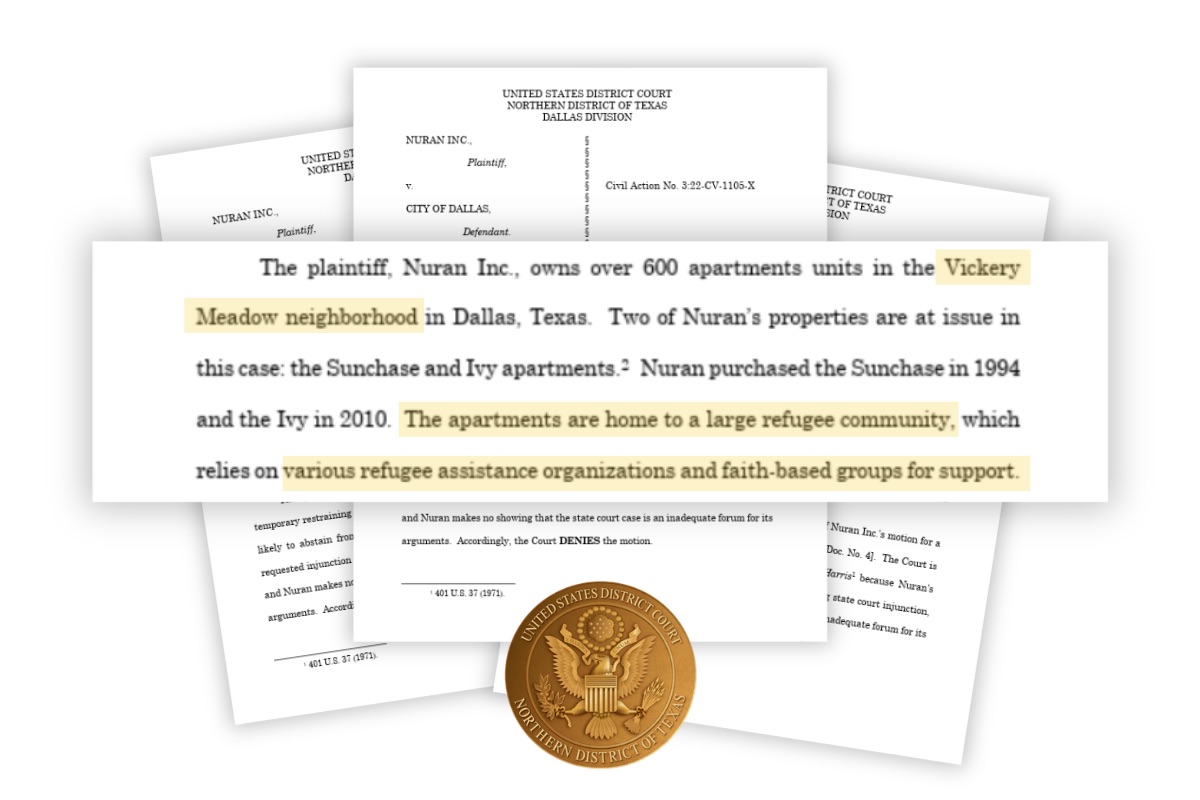
According to city code compliance filings and extensive investigative reporting by KERA-FM, municipal inspectors cited Nuran-owned complexes for over 70 city and fire code violations (opens in a new tab) in 2021 alone.
Challenging a landlord to fix an air conditioning issue, repair a broken window, or even update staircases to suitable code becomes an intimidating exchange. Refugee and immigrant communities already lack confidence as they navigate this unfamiliar country — insecurity, compounded by language barriers and little understanding of American legal institutions, leaves them both emotionally and financially spent.
When property owners realize their tenants have few legal or financial alternatives, deferred maintenance is no longer an oversight. Unaddressed leaks, faulty wiring, and issues that pervade the structural integrity of safe housing are not merely inconveniences; they are direct violations of municipal health and safety standards. Such subversion exploits the vulnerability of newly arrived and low-income families.
This neglect is fueled by a severe shortage of affordable housing (opens in a new tab) across Dallas. Exploitative landlords recognize that desperation eliminates competition, allowing repeat-offender property owners to cut maintenance costs and ignore city codes with little fear of vacancies.
The policy problem
This situation draws attention to Dallas’ competing municipal responsibilities:
- The Duty to Protect Habitability: The city has an obligation under Chapter 27 of the Dallas City Code (opens in a new tab) to ensure that housing meets basic health and safety standards.
- The Threat of Displacement: Traditional punitive enforcement without an affordability safeguard carries unintended risks. Levying steep fines or issuing emergency condemnations could close complexes overnight, leaving many without a place to stay. Alternatively, forcing extensive private capital improvements might lead landlords to pass renovation costs onto tenants or sell to commercial redevelopers — effectively erasing any sub-$1,000 housing stock that refugee integration relies on.
On one hand, the city has an obligation to ensure that rental housing meets basic health and safety standards for all its residents. Allowing landlords to neglect properties because their tenants are desperate and of low-socioeconomic status effectively creates a lower standard of living for immigrant and refugee communities in the Dallas area.
On the other hand, aggressive enforcement without an affordability strategy will have its own consequences. Requiring significant improvements to Vickery Meadow complexes could increase the cost of maintaining property. Redevelopment might be preferred; it will invariably increase rent costs for a community whose paychecks cannot keep up.
In an economic state where low-cost apartments are already scarce, either outcome can push residents out.
This contradiction is the center of the Vickery Meadow housing issue. Dallas cannot protect affordability by turning a blind eye to inadequate living conditions. But improving them has little potential if the affected communities cannot afford to live there.
The city’s challenge requires shifting from reactive, complaint-drive code inspections to an active framework that pairs aggressive repeat-offender accountability with the opportunity for public-nonprofit acquisition.
What we can do
A regulatory posture that relies on vulnerable tenants to blow the whistle will always fail against entrenched property owners. At the same time, aggressive enforcement cannot happen in a vacuum.
The City of Dallas is already short approximately 39,900 affordable rental homes for households earning 50% or less of Area Median Income (opens in a new tab). The shortage is projected to exceed 70,000 units by 2033. Allowing existing affordable apartments to become uninhabitable only makes this crisis worse.
To escape this trap, Dallas should look to regulatory frameworks deployed in high-density markets like New York, where chronic code violators face inter-agency accountability.
This policy analysis recognizes that Texas and New York are diverse in terms of fiscal, political, and ideological standings. But what is important to highlight is the creation and implementation of an effective solution to a similar problem.
The New York State Senate offers the following policy suite:
- The New York State Senate Fire Safety & Code Package (opens in a new tab) (2022): Passed in the wake of fatal residential fires in aging housing, this legislation updated building codes and created designated compliance monitors. It also expands legal remedies for code infractions, and an increase to minimum fines for life-safety violations. It forces property managers to prioritize urgent repairs.
- New York City Executive Order 08 (opens in a new tab) (2026): This executive order was issued to crack down on repeat offences of hazardous conditions. EO 08 mandates multi-agency coordination among housing, buildings, and consumer protection departments to ensure that violations are documented and addressed on an expedited timeline.
- The Alternative Enforcement Program (AEP) (opens in a new tab): AEP is New York State’s long-standing mechanism for placing the most distressed multi-family buildings under intensive municipal scrutiny (about 200-250 buildings per year) where they shift inspection costs onto the landlords. They then use city-contracted repairs when needed that are billed back to owners when they refuse to make necessary repairs.
Dallas cannot simply copy and paste New York’s regulatory model.
However, Texas law provides its own underutilized municipal enforcement tools. Under Chapters 54 (opens in a new tab) and 214 of the Texas Local Government Code (opens in a new tab), cities hold unambiguous police powers to enforce public health, sanitation, and safety standards; levy substantial civil penalties; and intervene in chronic public nuisances.
Adapting the intent of New York’s repeat offender framework, within the bounds of Texas jurisprudence, I propose a three-part strategy:
- Establish an Inter-Agency Repeat Offender Program (ROP) with Cost-Shifting Fees
- Automated Identification Triggers: Instead of waiting for vulnerable tenants to file repeat 311 (opens in a new tab) complaints, properties will be placed into the ROP automatically once they accumulate a defined threshold of unresolved tier-1 life-safety violations (e.g., inoperable heating/cooling during extreme weather, major water leaks, missing fire safety equipment, chronic pest infestations, etc.) over a 12-month period.
- Unified Enforcement Task Force: Dallas should combine Dallas Code Compliance, Dallas Fire-Rescue, and the City Attorney’s Community Prosecution Division into a joint task force. Such a cross-agency team eliminates municipal runarounds and ensures that respective issues are cited simultaneously.
- Mandatory, Owner-Funded Reinspection: Rather than subsidizing chronic offenders through taxpayer-funded inspections, ROP-designated complexes must be subjected to mandatory quarterly audits, with the full cost of inspections and re-inspections subjected to the landlord.
- Enforce Daily Civil Fines and Judicial Receivership
- Rather than settling for one-off citations, the city attorney should aggressively invoke Chapter 53 to seek maximum statutory civil penalties of up to $1,000 per day per violation against noncompliant landlords.
For chronically delinquent properties where such injunctions fail, the city should petition state district courts to appoint a health and safety receiver under Chapter 214. The receiver would take temporary operational control to collect rent and finance structural repairs directly, effectively allowing for the remediation of hazards without displacing tenants.
- Rather than settling for one-off citations, the city attorney should aggressively invoke Chapter 53 to seek maximum statutory civil penalties of up to $1,000 per day per violation against noncompliant landlords.
- Build an Acquisition Pipeline for Permanent Affordability
- To prevent distressed properties from being sold to speculative developers who will price out and displace low-income immigrant and refugee families, Dallas should direct acquisition capital to mission-driven and non-profit buyers.
The city should allocate a portion of its $2.18 million in its FY2025-2026 Residential Development Acquisition Loan Program (RDALP) (opens in a new tab) to help vetted entities and the Dallas Housing Finance Corporation acquire distressed complexes exiting litigation with low-interest financing to preserve affordable residential stock and housing justice.
- To prevent distressed properties from being sold to speculative developers who will price out and displace low-income immigrant and refugee families, Dallas should direct acquisition capital to mission-driven and non-profit buyers.
For the thousands of refugees who arrive in North Texas each year, safe and affordable housing is not a secondary concern. It is the foundation upon which every other aspect of resettlement depends.
Accepting unsafe living conditions as the price of affordability is not just an issue of economic inevitability, but a public policy failure. One that the City of Dallas is well-equipped to amend.
Families should not have to choose between a home they can afford and a home that is safe to live in.
Muntaha Sabir, a second-year student in SMU’s Master of Public Policy program, is editor of The Public Square.
Request information
To learn more about the Master of Healthcare Administration, Master of Public Administration and Master of Public Policy programs at SMU and download a brochure, please fill out the form. You can also talk one-on-one with an enrollment specialist directly by calling 469-871-6018.
