
The Public Square · Essay
More than 50 million Americans (opens in a new tab) now live in communities with limited or no access to local news. That is not just a media problem. It is a democracy problem.
Across the country, local newspapers have closed, reduced coverage, or been absorbed by distant ownership groups. When that happens, school board meetings go uncovered. City council votes receive little scrutiny. Local elections unfold with minimal reporting. Residents are left to rely on national outlets or social media feeds that rarely focus on decisions affecting their daily lives.
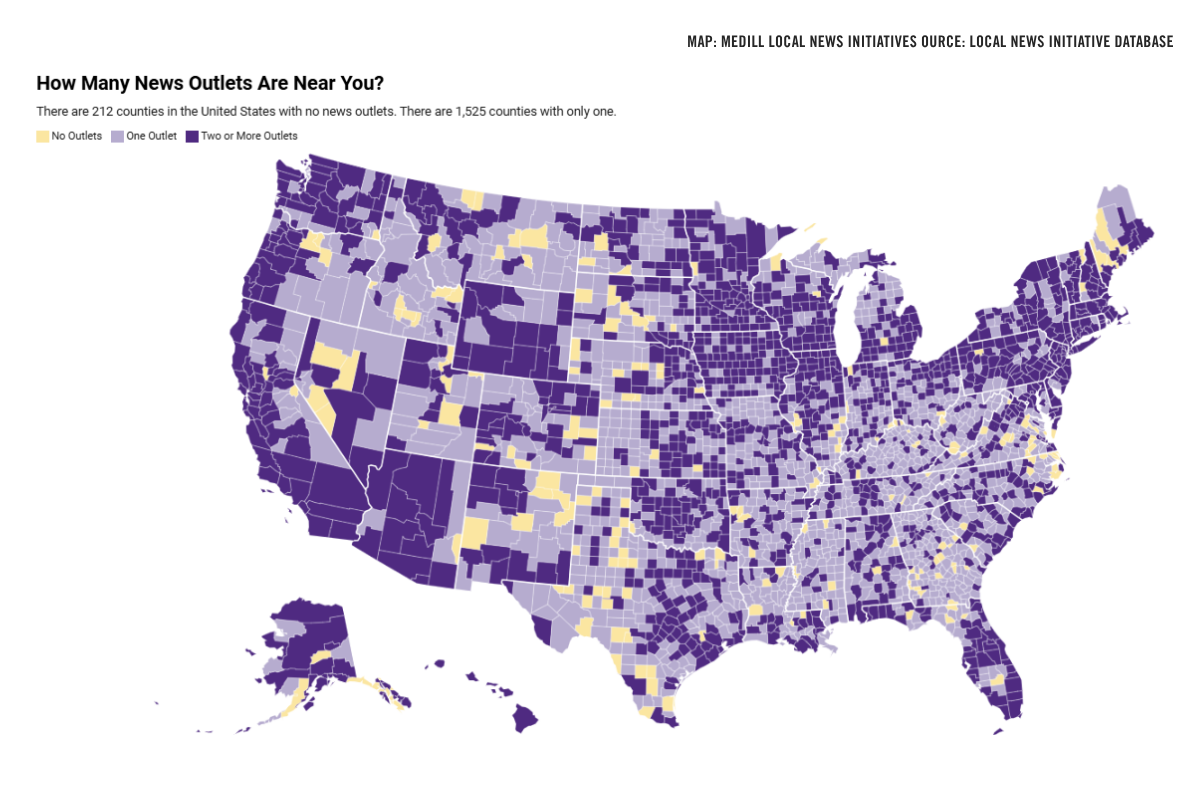
States with large numbers of news deserts face a choice: Treat this reality as a market failure and walk away or recognize local journalism as a public good worth protecting?
Some states are considering proposals to invest in local journalism as a public good. That includes California and New Jersey, where both states have approved direct investments in qualifying newsrooms.
In 2025, New Jersey (opens in a new tab) provided more than $12 million to qualifying “civic information providers,” which included local newsrooms. The maximum an organization could receive (opens in a new tab) for a project was $100,000.
In California, the state decided to allot $10 million this year to eligible print and digital publishers through a to-be-determined formula. Google is matching the state’s $10 million contribution.
Some people will dismiss such direct investments. But the concept deserves serious support, with clear guardrails.
The case for public investment begins with civic engagement. Research (opens in a new tab) consistently shows that communities without strong local journalism experience lower voter turnout and weaker political accountability. When no one is consistently covering public institutions, problems are easier to hide. Corruption arises. Public spending faces less scrutiny. Citizens disengage.
Small towns and rural communities are especially vulnerable. Large metropolitan papers like The Dallas Morning News still have scale, advertising markets, and brand recognition. Smaller weeklies and digital startups in towns outside major cities often do not have that. These outlets operate with thin margins, limited staff, and shrinking ad revenue. Yet they are the only sources reporting on county commissioners, bond elections, or school district policies.
For voters trying to understand local electoral races, access to credible reporting matters. National media rarely cover ballot initiatives, judicial contests, and school board elections. Without local journalism, residents are left with campaign mailers and social media claims. That weakens informed participation.
At the same time, state funding for news raises legitimate concerns. Government money flowing into newsrooms can create the perception of political influence, even if none exists. Editorial independence is the backbone of public trust. If readers believe coverage is shaped by state funding decisions, trust erodes.
That tension does not mean investment is impossible. It means design matters.
Funding must be structured to protect independence and target true local needs. Several criteria would help.
First, eligibility should be limited to independently owned local news organizations serving communities under a defined population threshold or in federally recognized news deserts. This prevents larger, well-capitalized outlets from capturing funds intended for fragile operations.
Second, qualifying organizations should demonstrate that a significant portion of their coverage focuses on local public affairs, including schools, local government, courts, public safety, and community issues. The goal is civic information, not lifestyle branding.
Third, funds should be distributed through an independent oversight board insulated from direct political control. Members should include journalists, academics, and community representatives with staggered terms. Lawmakers should not have discretion to reward or punish outlets based on coverage.
The fourth criterion must be content-neutral. The state cannot evaluate outlets based on viewpoint, ideology, or editorial stance. Constitutional safeguards require neutrality. Transparency about application scoring and awards would further protect legitimacy.
Fifth, funding should be modest, predictable, and time-limited. A public investment will not solve structural revenue problems. It can, however, help cover a reporter’s salary supplement, public records costs, or digital infrastructure upgrades. The purpose is stabilization, not dependence.
Critics will argue that direct public investment risks turning journalism into a quasi-government service. That concern deserves attention. However, the United States previously supported media in limited ways, including public broadcasting. The key lesson from public broadcasting is that diversified funding streams and strong governance structures reduce political pressure.
The greater risk may be in-action. Market forces alone have not sustained local journalism in many communities. Advertising has migrated online. Classified revenue collapsed. Private equity ownership has stripped assets from some papers. In many towns, the market has spoken, and the result is silence.
Silence carries costs. Studies link news deserts to higher municipal borrowing costs and lower civic participation. When fewer reporters attend public meetings, fewer citizens know how tax dollars are spent. Information asymmetry increases. Accountability declines.
A carefully structured state investment acknowledges that local journalism produces public value beyond what the market captures. Just as states invest in roads, libraries, and schools because they support civic life, modest support for local news recognizes its democratic function.
That support must remain conditional and transparent. Annual reporting requirements should document how funds are used. Metrics could include the number of local public meetings covered, investigative pieces published, or community engagement initiatives launched. These are performance indicators, not editorial directives.
Importantly, this policy should complement, not replace, broader innovation. Newsrooms must continue experimenting with digital subscriptions, memberships, nonprofit models, and collaborations. Public funds should not freeze outdated business models in place.
The decline of local news is measurable. The consequences are visible. When residents lack access to reliable local reporting, democratic participation weakens.
Legislators should approve targeted, carefully structured investment in qualifying local newsrooms. With strong guardrails, content-neutral criteria, and independent oversight, the state can help stabilize civic information without compromising editorial freedom.
Local journalism is not simply another private business. It is an infrastructure for democracy. When it disappears, public life narrows with it.
Imelda Gutierrez is a student in SMU’s Master of Public Policy program and a public school educator in Dallas.
Request information
To learn more about the Master of Healthcare Administration, Master of Public Administration and Master of Public Policy programs at SMU and download a brochure, please fill out the form. You can also talk one-on-one with an enrollment specialist directly by calling 469-871-6018.
