
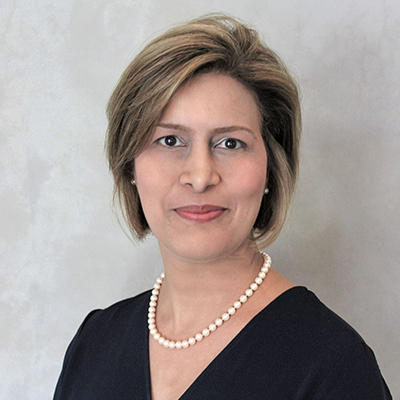
By Taylor Calvin, M.P.P. student and teaching assistant, featuring Mea Ahlberg, P.P.A. Faculty, Curriculum Committee Member and Senior Lecturer, SMU Department of Economics
The online M.P.P. and M.P.A. program recently sat down with Dr. Mea Ahlberg to discuss her passion for teaching, the role economics plays in shaping public policy and what she hopes students take away from her courses.
With a background spanning economics, public policy, international trade and national security, Dr. Ahlberg brings a multidisciplinary perspective to the classroom that encourages students to think critically about how policy decisions affect governments, markets and communities.
An award-winning educator and curriculum leader at SMU, she has become known for her engaging teaching style, commitment to student success and ability to connect complex economic concepts to real-world policy challenges.
An interview with Dr. Mea Ahlberg
You have received several recognitions from students and the university over the years, including multiple HOPE nominations and the Barbara and James Mangum Teaching Award. What do those recognitions mean to you as an educator?
Those recognitions truly mean a great deal to me because they come directly from students and reflect the relationships and learning environment built in the classroom.
Teaching has always been about more than simply delivering content. I want students to feel supported, challenged, engaged and confident in their ability to succeed.
Receiving HOPE nominations across multiple years, along with the Barbara and James Mangum Teaching Award, has been incredibly meaningful and motivating.
Economics can sometimes feel intimidating to students entering public policy or public administration programs. How do you approach teaching the subject in a way that feels accessible and relevant?
I try to connect economics to real-world public policy issues that students already care about, such as housing, healthcare, inflation, trade, national security, labor markets and government decision-making. Once students see how economics directly applies to policy and everyday life, the subject becomes much less intimidating and much more engaging.
I also focus heavily on creating an interactive and supportive classroom environment where students feel comfortable asking questions and participating.
What has been the most rewarding part of teaching graduate students in the M.P.P. program?
One of the most rewarding parts has been seeing students reach a point where their education gives them the tools and confidence to take the next step in their professional careers, advance into leadership positions or even pursue public office.
There is probably not a faculty member out there who does not feel a sense of pride when they see a former student on a campaign sign, speaking on television, leading an organization or making an impact in their community and think, “That was my student.”
Watching students grow professionally and realize the impact they can have on organizations, communities and public policy is truly one of the most meaningful parts of teaching.
What advice would you give students as they prepare for careers in public policy, government or related fields?
Stay curious, remain adaptable and always focus on understanding the broader implications of policy decisions. Public policy affects real people and communities, so maintaining both analytical rigor and empathy is essential.
I also believe it is very important to remain observant. You cannot develop solutions if you have not first recognized that a problem exists. Always pay attention to how systems, workplaces, cities, organizations and even households can be improved, and then think about what policies or recommendations could help make those improvements happen. That is ultimately how societies and institutions continue to grow and improve over time.
Communication is also equally important. You can have the best idea, the best analysis or the best policy recommendation, but if you are not able to communicate it clearly in a way that allows others to understand, visualize and support your ideas, it becomes much harder to create meaningful change. The ability to explain complex problems and solutions clearly, professionally and persuasively is one of the most valuable skills students can develop for careers in public policy and public administration.
What skills or qualities do you think help students succeed most in today’s public policy and public administration careers?
Strong analytical thinking, communication skills, adaptability and problem-solving abilities are extremely important. The ability to work with data while also communicating ideas clearly to different audiences is becoming increasingly valuable. I also think students who remain intellectually curious, collaborative and open to different perspectives tend to be especially successful in today’s public policy environment.
Lead the way in policy with SMU’s M.P.A. or M.P.P.
SMU’s online Master of Public Administration and Master of Public Policy degrees equip students with crucial skills to make meaningful change through policy and public administration. Our curricula, which can be tailored to your interests, emphasize practical application so that you can feel confident in your ability to use policy tools and management skills. You’ll collaborate with peers, gain insight from policy professionals and benefit from the expertise of our distinguished faculty.
A nationally ranked private university near the heart of Dallas, SMU is a distinguished center for global research and teaching. SMU’s diverse, high-achieving students come from the U.S. and around the world to take advantage of the University’s small classes, innovation, leadership development and career opportunities that can provide a launch pad for global impact.
Download a brochure to learn more about the program, or start your application today.
Request information
To download a program brochure and learn more about the Master of Healthcare Administration, Master of Public Administration and Master of Public Policy programs offered by SMU, please fill out the form. You can also get in touch with an enrollment specialist directly by calling us at 469-871-6018.
